Why does someone want to buy from your online business
Understand why people buy, what makes them hesitate online, and how to earn trust, reach busy customers and give them a reason to stay.
Someone wakes up, checks a message, makes breakfast and gets on with their day. They have work to finish, people to look after, bills to pay and things they would like to do. Somewhere between those things, they open their phone or computer.
That is where your business might appear.
You have spent months thinking about your product. The person seeing it may give it only a passing glance. Your SaaS, mobile app or online store has to connect with something that matters in their life before they have a reason to investigate it.
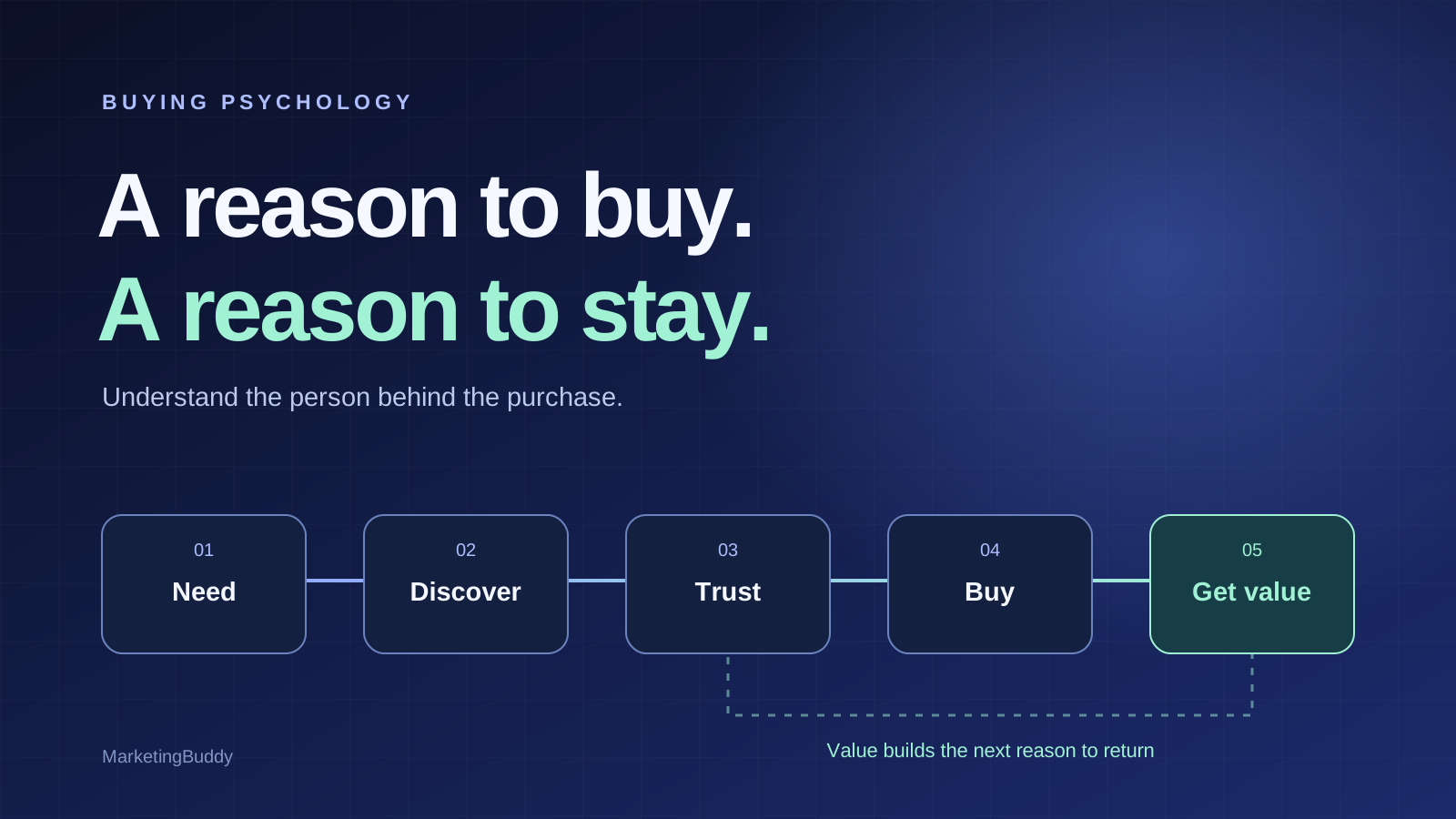
A useful starting point is this: people buy when they believe the outcome is worth the money, effort and uncertainty involved. Your job is to understand that outcome, make it believable and help the right person take the next step.
This guide walks through the reasons behind a purchase, the doubts that interrupt it, the everyday journey that brings someone to you, and the experience that makes them want to return. Throughout, the examples are illustrations you can adapt, rather than promises about how every customer behaves.
1. Humans buy something because they want something to change
A purchase can solve a practical problem, change how someone feels, help them express who they are, or bring a moment of enjoyment. Often, several motives operate together.
A founder might buy accounting software to organize invoices, feel in control and stop worrying about looking unprepared in front of an accountant. A person might buy a running app because they want a plan, encouragement and a way to become more consistent. Someone buying a jacket may care about warmth, fit, confidence and how it looks with clothes they already own.
Start with these possible motives and investigate which ones your customers actually describe:
| What the person wants | What that can sound like | A possible purchase |
|---|---|---|
| Relief from a recurring frustration | “I am tired of doing this manually every Friday.” | Reporting software |
| More time or less effort | “I want dinner sorted without another decision.” | A meal-planning app |
| Confidence and control | “I need to know I have not missed anything.” | A project management tool |
| Enjoyment or comfort | “I want something I will look forward to using.” | A game, coffee subscription or comfortable chair |
| Identity and self-expression | “This fits the kind of person I want to be.” | Clothing, a creative app or specialist equipment |
| Connection or recognition | “I want to share this with people who understand it.” | A membership, gift or hobby product |
These are research prompts. They are not fixed personality types, and the same person can have different reasons on different days.
Look underneath the feature
Take one feature and ask what it allows the customer to do. Then ask why that matters.
“Automatic reports” could mean “I can send the client an update without assembling five spreadsheets.” That could mean “I finish work on time and feel prepared for the meeting.” Now you have a situation you can demonstrate and language a customer might recognize.
For an ecommerce store, “machine washable” could mean “I can use this every day without worrying about an expensive cleaning routine.” For a mobile app, “offline mode” could mean “I can use the lesson on the train even when my connection disappears.”
The feature matters because of the experience it makes possible. Your page needs both: the human reason to care and the concrete details that support it.
Pause and reflect: What happens in your customer's life before they need your product? What becomes easier, better or more enjoyable after they use it?
2. A person needs a reason to choose your business
Understanding why somebody wants a category of product is only the beginning. They still have to decide whether to buy yours, choose another option, keep their existing workaround or postpone the decision.
Compare your offer with what the person actually does today. A small business might compare your SaaS with a spreadsheet and an assistant. A new mobile app might compete with a free app they already understand. Your store might compete with a familiar retailer that can deliver before the weekend.
That comparison includes more than the price:
- Fit: Does this solve my particular problem or suit my preferences?
- Evidence: Can I see that it works in circumstances like mine?
- Total commitment: What will I spend on money, setup, learning and maintenance?
- Downside: What happens if it disappoints me?
- Timing: Is this useful enough to act on now?
For business software, the user and the person approving payment may be different people. A team member may want easier reporting while their manager wants a clear business case and the IT team wants answers about access and data. Give each person information they can use to move the decision forward.
Try completing this sentence:
When [specific situation] happens, [specific customer] chooses us to achieve [desired outcome], because [credible reason we fit], with [clear explanation of the commitment].
For example: “When a freelance designer has three projects overlapping, they choose our planner to keep client deadlines visible, because it comes with a workflow built for solo design projects and can be tried on one project first.”
That gives you something useful to build a landing page around. “The ultimate productivity platform” leaves the visitor with much more work to do.
3. Why people buy something online
Buying online lets someone act when and where the need appears. They can compare options during a break, find a specialist product unavailable nearby, read detailed specifications privately and complete a purchase without organizing a trip to a shop.
For software, online purchasing can lead directly to use. For physical products, it can provide access to a broader selection and delivery to a convenient place. For apps, discovery and installation may happen on the same device where the product will be used.
But the convenience comes with gaps. The customer may not be able to touch the product, try the fit, watch a live demonstration or look someone in the eye. They must judge a business through a screen.
Your website has to provide the missing information. Show real product details, how the service works, what the buyer receives and what happens after payment. Make those answers usable on a phone, while someone is distracted and deciding whether to come back later.
Online shopping also makes comparison easy. A visitor leaving to check another option is a normal possibility. Build a clear, memorable explanation they can carry into that comparison: who you help, what you help them do and why you are a credible choice.
4. The psychological hurdles that stop an online purchase
Hesitation is useful information. A person may want the outcome while remaining unsure about the product, the business or the commitment. Diagnose the uncertainty before changing the offer.
Baymard's research with US online shoppers identifies costs, delivery speed, payment trust, account requirements and checkout complexity among reported reasons for abandonment. It also separates people who are simply browsing or not ready to buy. Those findings concern ecommerce checkout; they are prompts to investigate your audience, rather than a conversion benchmark for every app or SaaS. See Baymard's cart abandonment research.
Here is a working checklist for your own customer research:
| The thought behind the hesitation | What to investigate or show |
|---|---|
| “I don't understand what this does.” | A plain explanation and a demonstration of one useful task |
| “Will it work for someone like me?” | Relevant use cases, compatibility details, fit guidance and realistic limitations |
| “I might waste my money.” | A clear price, an accurate preview and understandable trial or return conditions |
| “Switching sounds exhausting.” | The actual setup process, import options and support available |
| “I already have something that works.” | A concrete improvement large enough to justify changing |
| “There are too many options.” | Meaningful differences between plans or products and guidance on suitability |
| “I don't know what you're going to do with my information.” | An accessible explanation of data use and the choices the customer has |
| “I cannot deal with this right now.” | An easy way to save progress or return to the same product |
Uncertainty can make the familiar option feel easier
An existing tool can have obvious shortcomings and still be comfortable to keep. The customer knows its problems; they do not yet know yours. Show the transition honestly, including what takes time and what help is available.
For a store, uncertainty might concern size or material. For a SaaS, it might concern migrating years of records. For an app, it might concern whether setup will take longer than the benefit is worth. A discount does not answer all of those questions.
Effort and timing matter alongside desire
BJ Fogg's Behavior Model describes action through the meeting of motivation, ability and a prompt. Applied to a purchase, it offers a useful diagnostic: does the person want the outcome, can they take the next step easily, and is the invitation arriving at a workable moment?
Our practical application is to examine the step you are asking for. A visitor interested in a demonstration may be happy to watch it now but unable to complete an account setup on a crowded commute. Let the next action match the situation.
Treat attention as something the person is lending you
An interruption, a confusing phrase or a broken field can end a visit. Put the information needed for the current decision close to the action. Use recognizable labels and explain what happens next.
Pause and reflect: What would a cautious stranger need to understand before giving you money? Which of those answers currently requires searching your site or contacting support?
5. Build trust with evidence people can inspect
Trust grows through the claims you make and the experience of checking them. A polished page can help someone get oriented, but the substance must hold up when they look closer.
Nielsen Norman Group's research on website credibility connects trust with design quality, upfront information, useful current content and evidence beyond the company's own website. A practical application is to make your important claims easy to verify.
Keep the evidence close to the promise. If you say setup is straightforward, show the steps. If you say a backpack fits a laptop, give dimensions and show it packed. If you say a tool suits agencies, demonstrate a real agency workflow. Get permission before publishing customer stories, and distinguish an illustrative example from an actual customer's results.
Specificity helps the buyer judge relevance. A case study can explain the customer's starting point, what they used, how long it took and what changed. A review is more useful when it describes the circumstances of use. Neither should suggest that every buyer will get the same result.
You can also earn trust before having many customers. Offer an honest demonstration, accurate documentation, clear ownership and a working way to contact you. Explain who the product suits and where its limits are. Invented reviews or decorative claims would undermine that work.
Carry the same clarity into the purchase: what is included, what renews, when an order arrives, how support works and how someone can leave. Make any meaningful conditions easy to find before payment. A customer should be able to repeat the agreement back in ordinary language.
Pause and reflect: Which claim on your homepage is hardest to prove? What could you show this week that would help a buyer assess it?
6. Understand the customer journey inside a busy day
A customer journey is the sequence of situations and interactions through which someone notices a need, discovers options, evaluates them, buys and uses what they bought. It continues through support, renewal, repeat purchases and recommendations.
The sequence can loop. Google's research on purchase decisions describes shoppers moving between exploring possibilities and evaluating choices. That is a useful reminder that an ad click, a review and a return visit may belong to the same decision.
Imagine these moments in one possible day:
| Moment | What the person might be doing | A useful interaction with your business |
|---|---|---|
| Before work | Scrolling while waiting for breakfast | A brief example of a recognizable problem |
| During work | Searching for a way to finish a task | A specific explanation, tutorial or product page |
| At lunch | Comparing a few options on a phone | Clear differences, pricing and relevant proof |
| Later at a computer | Checking compatibility or asking a colleague | Documentation, a demo or a shareable comparison |
| In the evening | Returning when they can concentrate | The same saved item, plan or unfinished setup |
| After purchase | Trying to get the promised result | A useful first step and accessible help |
These are illustrative moments, not universal best times to post. Interview your audience to find its real routines. A parent, a night-shift worker and a purchasing manager may have very different windows of attention.
A SaaS journey
A small agency owner struggles to explain campaign results before a client call. They search for a reporting template, find your guide and use part of it. Later, they watch your software demonstrate the same job, check whether it supports their tools and send the pricing page to a colleague.
They start a trial when they have time to connect one account. The meaningful next milestone is a report they can actually use. Your journey should support each step: useful discovery content, relevant evidence, clear setup and a first result.
A mobile app journey
A commuter sees a short video showing how a language app helps practice a travel conversation. They save it, inspect the app listing later and try a lesson. They may consider paying once they understand the experience and how it fits their routine.
The listing should represent the actual app. The first session should connect with the situation shown in the video. Ask about reminders when their purpose is clear and let the user choose a workable time.
An ecommerce journey
A traveler sees a bag packed for a weekend trip. Later, they search for its dimensions, compare it with their airline's allowance, check customer photos and ask whether it will arrive before departure.
The decision may depend on practical answers: capacity, comfort, delivery and returns. After purchase, accurate order updates and a product that matches the demonstration become the basis for buying again or recommending it.
Across all three journeys, the person is fitting your business around their life. Build for interruption, comparison and return visits. There is no fixed number of interactions that every customer needs before buying.
7. Find out what your own customers are thinking
Analytics can show where people leave. Conversations can help explain what was happening when they did. Use both, and avoid treating either as a complete account of the decision.
Start with a small set of recent buyers, people who considered buying, and customers who stopped using the product. Five conversations in each available group can be a practical first round; it is not a statistically representative sample.
Ask about a real episode:
- What was happening when you first started looking?
- How were you handling this before?
- Where did you look, and what did you compare?
- What made this option worth a closer look?
- What almost stopped you buying?
- What made you decide when you did?
- What happened the first time you used it?
- What would make you continue, leave or recommend it?
Let the person tell the story before suggesting explanations. “What happened next?” often produces better evidence than “Would a cheaper plan have helped?” A stated future intention is weaker evidence of purchasing behavior than a specific account of what someone actually did.
Record their language, the source of the observation and the uncertainty. Keep separate notes for what you heard and what you infer. If three customers describe the same setup problem, investigate it; do not immediately assume every customer has it.
Then turn an observation into a test: “Visitors cannot tell whether this supports their existing store. We will make compatibility clearer and watch whether relevant visitors reach setup successfully.” That connects a change to a real hurdle.
8. Reach more of the people your business can help
The internet offers access to a large audience, but your reachable market depends on who has the need, can use the product and can reasonably buy it. Growing means finding more of those people and making their next step easier.
Define a starting segment through a situation. “Small businesses” is broad. “Independent store owners who assemble their weekly sales report manually” gives you a problem, a likely search and a possible demonstration.
Be discoverable when the need is active
Build pages around questions your customers actually ask: how to do the job, whether your product is compatible, how two options differ, or what a product looks like in use. Search, app listings, marketplaces and relevant directories can connect you with people already investigating.
Write the page to complete the task behind the search. A person looking for dimensions should find dimensions. A person comparing plans should be able to understand the differences. Relevant information gives the right visitor a reason to continue.
Show the situation where your audience spends time
Demonstrations, useful explanations and customer stories can introduce an option before someone searches for it. Choose a small number of places your research suggests customers use: a professional community, a specialist newsletter, a creator's channel or a social platform.
A channel is a hypothesis to test. Speak with customers, inspect the responses and follow the visitors through to meaningful use. A large audience on one platform does not establish that your buyers are there or that they are receptive to your offer.
Participate in communities by helping with the discussion and following their rules. Partners and creators should understand the product well enough to explain its fit accurately. An audience built on the wrong expectation creates disappointment later.
Give interested people a useful way back
Offer an optional saved cart, a relevant email guide, a bookmarkable demo or a reminder the person chooses. Keep the context: someone who asked about setup should return to help with setup.
Use follow-up and advertising with appropriate permission and frequency. Once someone buys, move the conversation toward using the purchase successfully. Repeatedly showing an acquisition offer after payment can make the experience feel disconnected.
Expand with evidence
Begin with one clear audience, one strong offer and one or two channels you can learn from. Try paid distribution within a defined budget once the destination and measurement are ready. Expand into another use case, region or channel when you can support the customers it brings.
Consider this hypothetical comparison: 10,000 visits with a 0.1% purchase rate produce 10 purchases; 1,000 visits with a 2% purchase rate produce 20. Neither result tells you profitability without costs, order value and retention, but the arithmetic shows why traffic alone is an incomplete target.
For more practical distribution ideas, see our guide to getting your first 100 users.
9. Keep customers by delivering the reason they bought
Payment creates a new question: “Did I make a good decision?” Help the customer answer it through the product and service they receive.
Choose a first useful result for each major customer situation. For a reporting SaaS, that could be creating a report from real data. For a language app, completing a lesson that fits a personal goal. For a store, receiving the right item on time and knowing how to use or care for it.
Make onboarding lead toward that result. Explain necessary setup in context, show progress and make help accessible when something goes wrong. Avoid equating completed profile fields with customer success.
After the first result, understand the natural rhythm of value. A monthly planning tool may be valuable without daily use. A durable product may lead to recommendations long before another purchase. Evaluate retention against the job and buying cycle, rather than assuming every business should maximize daily sessions.
Helpful follow-up responds to the customer's stage: instructions after delivery, a setup tip after a failed connection, a reminder before a genuine replenishment need, or a relevant product improvement for someone who asked for it. Our guide to four useful email flows offers starting points.
When someone leaves, make the process clear and learn what you can. The problem may have disappeared, their needs may have changed, or your product may have failed to deliver. Treat those as different situations. Friction that traps an unhappy customer does not create satisfaction.
Ask for reviews or referrals after customers have had a fair opportunity to experience the product. Let them describe the actual outcome in their own words.
10. Measure the journey from attention to lasting value
Choose measures that answer a question at each stage:
| Stage | Question | A useful measure to consider |
|---|---|---|
| Discovery | Are we reaching relevant people? | Visits or responses from the intended audience and source |
| Evaluation | Are they finding what they need? | Progress to a meaningful demo, product selection or pricing decision |
| Purchase | Can interested people complete the commitment? | Purchases relative to checkout starts, or paid subscriptions relative to eligible trials |
| First value | Do new customers achieve the initial outcome? | Share reaching a defined result, and time taken |
| Retention | Does the value continue? | Renewals, repeat purchases or continued useful activity over a suitable period |
| Economics | Can we support this growth? | Acquisition cost alongside contribution margin, refunds and support costs |
Define each measure and its time window before comparing it. Separate groups of customers who started around the same time, and allow enough time for their buying or renewal cycle. A channel bringing inexpensive signups may look different once you examine paying customers who stay.
Use attribution as an estimate. A person may discover you on their phone, discuss the product privately and later buy from a computer. Ask buyers how they found you alongside the recorded source. Those accounts can reveal interactions your tracking cannot see.
Make sure your events reflect real actions before relying on the numbers; our tracking checklist can help. With small samples, look for recurring problems and useful directional evidence while acknowledging uncertainty. A few extra purchases do not establish a universal rule.
11. A worksheet for your online business
Write a short answer to each prompt. Use customer evidence where you have it and mark assumptions where you do not.
- The person: Who can use and afford this, and in what specific situation?
- The trigger: What happens that makes them start looking?
- The desired change: What do they want to do or feel differently?
- The current option: What are they using, buying or tolerating today?
- The reason to choose us: What makes our offer a credible fit?
- The hesitation: What might feel unclear, risky, expensive or difficult?
- The evidence: What can we show that answers that hesitation?
- The encounter: Where and when might they come across us during a real day?
- The next step: What action fits their readiness and available attention?
- The first result: How will they recognize that the purchase was worthwhile?
- The reason to return: What continuing value, service or future need brings them back?
- The next experiment: What is one change we can make, and what would count as useful evidence?
Use the answers to plan one week of work: talk to customers, improve one confusing page, add one piece of credible evidence and test one route to a relevant audience. Review the experience after purchase as carefully as the advertisement that brought the person there.
The question to keep returning to is the one in the title: why would someone want to buy from your online business? Answer it in the language of their day, support it with something they can see, and deliver it when they become a customer.
- Buying psychology
- Customer journey
- Customer research
- Trust
- Retention
Let your AI run the marketing. You keep the final say.
Connect your ads, analytics, store and email, and approve every change before it goes out.